
Post-offer drug testing means you extend a conditional job offer first, then require a drug test before the person starts work, and you apply the same requirement to everyone hired into the same job category. Done in that order, with a written policy and a medical review of results, it is the cleanest way to screen new hires. The practical risk is delay: a new hire who cannot test the same day sits idle while your schedule slips. Total Tox is a walk-in clinic in the Bronx that typically completes collections in under 15 minutes and delivers MRO-reviewed results within 24 hours, so the test stops being the bottleneck.
TL;DR
- Make the offer conditional in writing, then test. Federal rules let you require post-offer exams and tests if every entering employee in the same job category goes through them.
- DOT-covered drivers must have a verified negative drug result before their first safety-sensitive duty, and a pre-employment alcohol test under 0.04 if you test for alcohol.
- In New York City, most employers cannot make a marijuana or THC test a condition of hiring, with exceptions such as DOT-required testing. Check the job category before you order a panel.
- A positive result is not the end of the process: a Medical Review Officer (MRO) interviews the candidate before anything is reported to you.
- Walk-in, same-day collection with results in about 24 hours keeps start dates on schedule and your file audit-ready.
Table of Contents
- What post-offer drug testing is, and why the order matters
- Who may be tested: the “same job category” rule
- What your written policy should say
- DOT-covered jobs: testing is mandatory, and the clock matters
- Cannabis: the rule that changes your panel by location
- What happens on test day
- Handling a positive, refused or missed test
- Where the process usually slows down
- What Total Tox does for post-offer testing
- Our perspective
- FAQ
- Sources
What post-offer drug testing is, and why the order matters
“Pre-employment” and “post-offer” are often used for the same test, but the sequence is what protects you. A drug test given before any offer can pull in disability-related information at the wrong stage. Waiting until after a conditional offer keeps the hiring decision clean.
The EEOC’s ADA enforcement guidance explains the rule. After an applicant has a conditional offer and before starting work, an employer may make disability-related inquiries and require medical examinations, whether or not they are job-related, as long as it does so for all entering employees in the same job category. The same guidance says tests that detect current illegal drug use are not considered medical examinations under the ADA.
The regulation behind it, 29 CFR 1630.14(b), adds a record-keeping duty. Any medical information you collect goes on separate forms, in separate medical files, and is treated as a confidential medical record. Your drug test results do not belong in the general personnel folder.
California’s employer association makes the same point from the practical side: testing after the offer helps you avoid pre-employment inquiries that could be unlawful, such as asking about a prescription that might show up in a test.
Who may be tested: the “same job category” rule
The consistency rule is where most policies fail. You can test every conditional hire for a role, or every hire in a defined class of roles, but you cannot pick individuals because of a hunch. Minnesota’s workplace testing guidance says the employer may require testing after a conditional offer as long as every applicant who receives a conditional offer for the same position is required or asked to test.
For a staffing agency this means defining categories up front: warehouse associates, forklift operators, CDL drivers, clinical staff. Each category gets one panel and one process. For a construction firm it often means a different category for site laborers and for equipment operators.
If you want a full template, our guide to what a pre-employment drug testing policy should include covers the clauses in detail.
What your written policy should say
No single federal statute dictates a policy for private employers, so the best guide is the strictest state rules you operate under. Four elements recur in state law and federal model plans.
1. The offer is conditional. Vermont’s statute, for example, bars requiring an applicant to test unless the offer is conditioned on a negative result, the applicant has written notice of the procedure and the list of drugs tested, and the notice states that therapeutic levels of prescribed medication will not be reported. Nevada’s state program likewise says the offer should clearly state it is conditional on passing the test and requires written consent before collection.
2. Notice, in advance and in writing. Georgia’s workers’ compensation drug-free workplace rules require a one-time notice before testing that covers the types of testing, the consequences of a positive result or refusal, confidentiality, and the right to contest a confirmed positive within five working days of written notification. Even outside Georgia, those headings make a sound outline.
3. Consent. The candidate signs before collection. A refusal is treated as a declined condition of the offer, and California’s employer guidance notes that an employer may decline to hire someone who refuses the test.
4. Confirmation and review. A positive screen is not a final result. Georgia’s rules require a laboratory confirmation test for an initial positive, and federal programs route positives through an MRO.
Some states attach incentives to post-offer testing. Georgia offers workers’ compensation premium discounts to employers that test applicants after an offer is extended under qualifying programs. Ask your insurer or counsel whether a similar program applies where you hire.

DOT-covered jobs: testing is mandatory, and the clock matters
If the role is safety-sensitive under Department of Transportation rules, post-offer testing is not a policy choice. Under 49 CFR 382.301, a driver must undergo a controlled substances test before first performing safety-sensitive functions, and the employer cannot let the driver work until it has received a verified negative result from the MRO or a consortium/third-party administrator.
Alcohol is handled separately. The same regulation says pre-employment alcohol testing is conducted after a contingent offer, and the employer must not allow the person to begin safety-sensitive duties unless the result shows an alcohol concentration below 0.04.
Three practical consequences for HR:
- The start date depends on the lab and MRO, not the collection. A collection that is fast but results that are slow still leaves a driver idle. Our DOT pre-employment test checklist walks through the timing HR teams most often miss.
- Know who is covered. Our explainer on safety-sensitive employees under DOT helps you sort which hires fall under the federal rule and which fall under your own policy.
- Know the alcohol rules. The 0.04 alcohol testing rules apply to drivers and the clinics that test them.
Construction and field operations often want rapid alcohol checks before shifts as well. For DOT-covered work, that is the same regulated framework. For non-DOT sites, it is your own written policy, applied consistently.
Cannabis: the rule that changes your panel by location
A standard panel may include THC, but that is no longer safe to assume everywhere. Two examples show why the location of the job drives the test you order.
New York City. The city’s Commission on Human Rights states that covered employers may not test job candidates for marijuana or THC as a condition of employment, effective May 10, 2020, with exceptions for specific kinds of jobs. The city’s FAQ lists those exceptions, which include testing required under DOT regulations. It also confirms the rule concerns applicants, and that employers may still test current employees for drug use. If you hire in the Bronx or Queens, confirm the exception for the specific role before you add THC to a panel.
California. Government Code Section 12954, as amended by SB 1264 and operative January 1, 2024, makes it unlawful to discriminate in hiring based on off-the-job cannabis use or on a screen that finds nonpsychoactive cannabis metabolites. It does not bar discrimination based on a scientifically valid screen that does not look for those metabolites.
These are two examples, not a complete map. State and city law keeps moving, so have counsel confirm the rules for each place you hire. The point for your policy is simple: write the panel by job category and location, and keep DOT-covered roles on the federal panel.
The same discipline applies to prescription drugs. The opioid question is a good example, and opioids in the workplace is worth reading if your policy has to address legitimately prescribed medication alongside testing.
What happens on test day
What you want is a short, predictable sequence that produces a paper trail.
- Send the candidate with the offer letter and consent form. Name the collection site and what to bring.
- Collection under chain of custody. Federal programs use a Federal Custody and Control Form and require the collector to keep the specimen under line-of-sight control or secure storage until it is sealed for shipment. That record of each handoff is what makes a result defensible later.
- Laboratory analysis. The lab screens and confirms.
- MRO review. Under SAMHSA’s 2024 guidance, the MRO is a licensed physician who reviews positive, adulterated, invalid, rejected and substituted results, interviews the donor when required, and reports a verified result. The guidance also states that a confirmed positive laboratory result does not by itself identify someone as having misused drugs, which is why this step exists.
- Result to the employer, then to the file. Keep the result in the confidential medical file, not the general personnel file.
For a closer look at the review step, see our explainer on what an MRO-reviewed drug test means.
Healthcare employers have a parallel track: clinical hires also need credentialing and onboarding steps, and a physician onboarding checklist shows where a drug screen fits in that sequence.
Handling a positive, refused or missed test
Decide the rules before the first positive arrives.
- Positive result. Wait for the MRO’s verified result. Nevada’s program, for example, has the MRO ask the candidate for proof of a lawful prescription and does not allow hiring if proof is not provided within 72 hours of the request. Georgia requires employers to inform the applicant in writing within five working days of receiving a confirmed positive, including the consequences and options. Use the shorter of the deadlines that apply to you.
- Refusal or tampering. Nevada treats adulterating, diluting or substituting a specimen, sending an imposter, or refusing to sign required forms as grounds to revoke the conditional offer. Your policy should name the same behaviors and the same outcome for everyone.
- Missed appointment. Set a window, for example a number of business days from the offer, after which the offer lapses. Walk-in availability makes this easy to enforce fairly, because the candidate cannot say no slot was available.
- Documentation. Record the offer date, the consent, the collection, the MRO result and the decision, each in the confidential file.
For DOT drivers who have a violation, the next stage is return-to-duty and follow-up. Our guide to DOT follow-up testing covers it.
Where the process usually slows down
Most delays come from logistics, not law:
- Candidates must book an appointment days out.
- The collection site closes before the candidate’s shift ends.
- Paperwork is incomplete and has to be redone.
- Results arrive without MRO review, so HR cannot act on them.
A walk-in site removes the first one. An accessible, bilingual clinic removes some of the confusion that causes the third. And a provider that issues MRO-reviewed results with audit-ready documentation removes the last. For evening or weekend hiring, see how after-hours drug testing can hold up in DOT audits.
What Total Tox does for post-offer testing
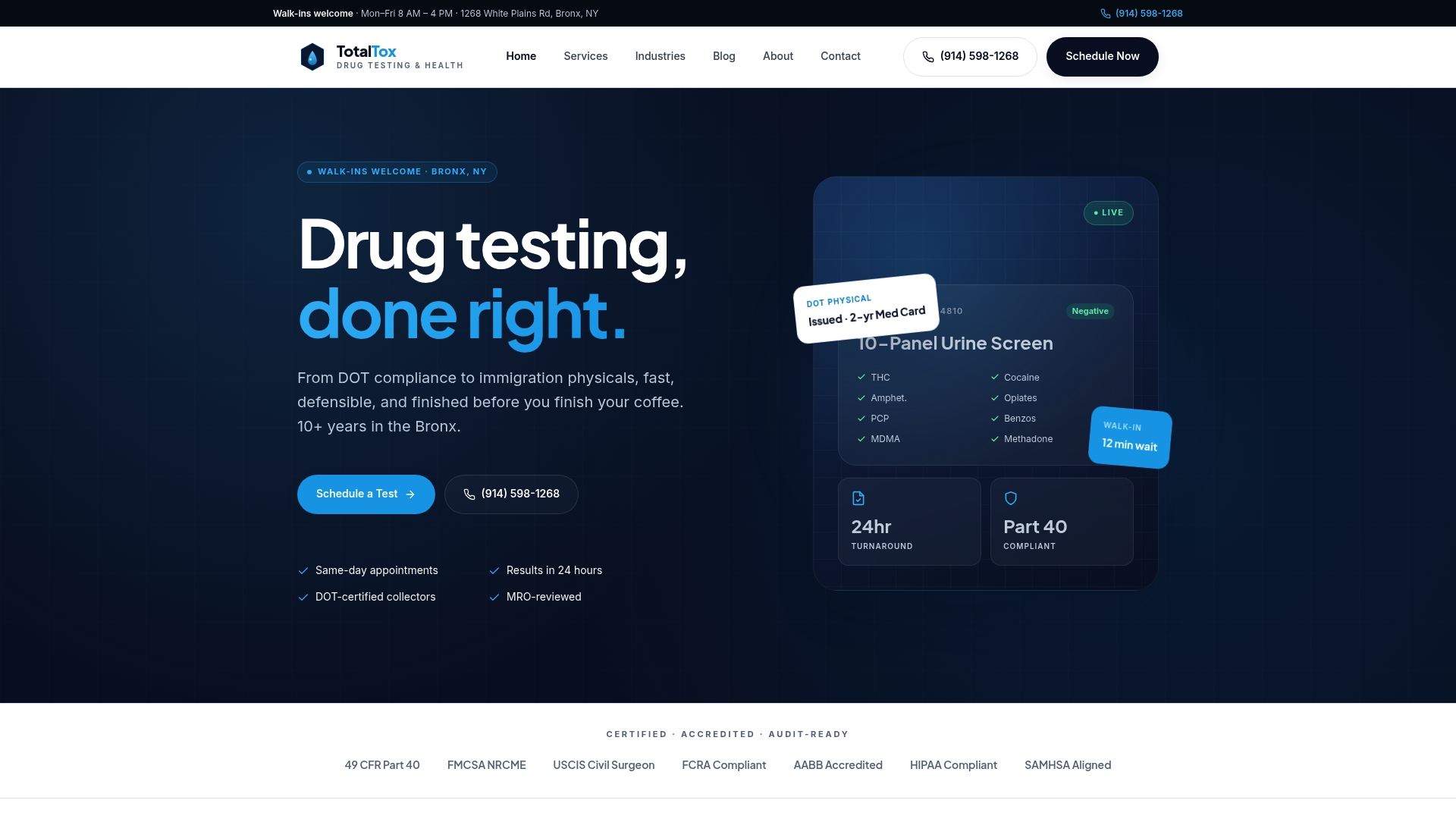
We run walk-in and same-day collections for the roles above: urine, saliva (oral fluid) and hair follicle drug testing, DOT drug and alcohol testing, DOT and employee physicals, and workplace pre-employment screenings. Collections typically take under 15 minutes, results are MRO-reviewed and typically arrive within 24 hours, and the paperwork is designed to be audit-ready for DOT, OSHA and USCIS requirements. We are a bilingual, ADA-accessible clinic serving employers across the Bronx and surrounding counties, and we also handle fingerprinting and background checks, so a new hire can finish several onboarding steps in one visit.
Staffing agencies, fleets and contractors can see everything we offer on our services page. Not sure which panel fits a role? Our comparison of hair follicle and urine testing explains how they differ.
Our perspective
Employers tell us the legal question is rarely the hard part. The hard part is the gap between the offer and the first shift. A candidate who cannot get tested the same day waits, a staffing client waits, and a crew goes short.
That is why we built our service around walk-in access and a short collection, with results reviewed by an MRO and documented so that an auditor can follow the file. The review step matters as much as the speed: a positive screen goes to a physician before it becomes a hiring decision, which protects the candidate and the employer.
Our advice is to settle three things before you recruit: the job categories you will test, the panel for each, and what happens after a positive, a refusal or a no-show. Write them down, apply them to everyone, and keep results in a confidential file. Then the test day is routine.
Total Tox
FAQ
Is post-offer drug testing legal?
Yes, in general. Federal rules allow employers to require post-offer examinations and tests when all entering employees in the same job category are treated alike, and the EEOC says tests for current illegal drug use are not medical examinations under the ADA. State and local laws add limits, such as the New York City rule on marijuana testing, so check your jurisdiction.
Can I withdraw the offer after a positive test?
You can condition an offer on the result, and federal rules for DOT roles bar a driver from safety-sensitive work without a verified negative. Wait for the MRO’s verified result, follow any state notice deadlines, and apply the same standard to every candidate in the category.
What should a post-offer testing policy include?
The conditional offer language, the job categories tested, the substances on the panel, consent, how results are reviewed and kept confidential, and the consequences of a positive result, refusal or tampering. Some states, such as Vermont and Georgia, require specific written notice before testing.
How long does a post-offer drug test take?
At Total Tox, collections typically take under 15 minutes on a walk-in basis, and MRO-reviewed results typically arrive within 24 hours. Timing for any lab result depends on the panel and on whether the MRO needs to speak with the candidate.
Sources
- EEOC Enforcement Guidance on Disability-Related Inquiries and Medical Examinations
- 29 CFR 1630.14, Medical examinations and inquiries
- HRCalifornia: How To Oversee Pre-Employment Drug Testing
- Minnesota House Research: Workplace Drug and Alcohol Testing
- Vermont 21 V.S.A. § 512
- State of Nevada Alcohol and Drug Program
- Georgia Code § 34-9-414
- O.C.G.A. § 34-9-415
- 49 CFR Part 382, Controlled Substances and Alcohol Use and Testing
- NYC Commission on Human Rights: Marijuana Testing in Employment FAQ
- California SB 1264, Employment discrimination: cannabis
- SAMHSA Medical Review Officer Guidance Manual, 2024
- Opioids in the Workplace: What Employers Should Do
- The Complete Physician Onboarding Checklist for 2026